Sunday, 7 April 2019

Angry Bird – Jungle Babbler


Dear followers hope you are doing great, vacation is round a corner for your kids and I am sure they must be demanding for a trip somewhere outside the city, give them a surprise by planning a trip to the forest. I have two reasons for suggesting a trip to the forest. The most important reason is we need to make aware our young generation about the importance of conservation of forest this will help us to save our forest for the bright future of our kids. The second reason is they are fond of animal and birds they can connect the experience with learning and yes they can enjoy the most, In case you need any help in planning the forest trip, you can reach me on btwildart@gmail.com

Forest and kids both are close to my hearts so I could not stop myself from recommending forest trip for kids. Now let us talk about today’s topic, today I am going to talk about a very common bird which is ignored by travelers most of the time but the bird is capable of giving superb frames if you notice them and devote little time, they surely deserve little attention at least. The bird is Jungle babbler, a commonly found in forest as well as city, let us learn more in the next section.  

The Angry Bird

We all know about angry bird cartoons and mobile game, try to relate the same with this bird, the looks are very similar to this bird, It looks that the cartoonist got the inspiration from Jungle babbler for few bird characters. 

Initially, when I started the wildlife photography, I was also ignorant of this sweet little bird, never used to take pictures one of the reasons is that keeps jumping from one place to other and it becomes difficult to capture. The friendship started from Bharatpur bird sanctuary where due to fog we had to wait for sunlight during the waiting time we saw some action from jungle babbler, they were playing in the group which was a treat to watch. The expression, the movement, communication with each other, the noise they were making, etc was absolutely funny and entertaining. This is where I realize that looks of jungle babblers are matching with an angry bird, you will also agree when you will see the pictures in My Canon World section, now let me tell you some facts about little one in the next section.

Seven Sisters

The scientific name of Jungle Babbler is Turdoides Striata. They are gregarious birds that forage in small groups of six to ten birds, a habit that has given them the popular name of Seven Sisters or Saat Bhai (Seven Brothers)

The jungle babbler's habitat is forest and cultivation. This species, like most babblers, is non-migratory and has short rounded wings and a weak flight

It is a noisy bird, and the presence of a flock may generally be known at some distance by the harsh mewing calls, continual chattering, squeaking, and chirping produced by its members

These birds are gregarious and very social, they feed mainly on insects, but also eats grains, nectar, and berries

Jungle Babbler sometimes forms the core of a mixed-species foraging flock, when foraging, some birds take up a high vantage point and act as sentinels. They are known to gather and mob potential predators such as snakes

Birds within a group often indulge in allopreening, play chases, and mock fights. When threatened by predators, they have been said to sometimes feign death (colloquially known as playing dead)

We can learn a few lessons of socialization from Jungle Babbler because they always stay in a group and never leave their group

Jungle Babbler always takes care of their kids very well. Mostly, Juvenile Jungle Babbler remains close to their parent

I have found a great ability in Jungle Babbler birds to communicate with you and you can do the same if you show some patience. I hope that with these pictures of Jungle Babbler and information, you can easily recognize this bird

A Message of the Day 

Save Life. Save Wildlife - The ones who have no voice need you to speak up


Author:

BT Wild Art
Life is Safari. Enjoy it.

My Canon World


Sunday, 31 March 2019

Largest Snake - Indian Python


Thanks reader for loving the space so much, your love towards blog motivates me to keep doing searches various species. Let me tell you that in a couple of weeks you will get a big trip review so keep visiting the space for some exciting report in coming time. 

Let me tell you even today’s topic is equally exciting because of various reason which I will disclose step by step. As routine I dipped into my wilderness studio where I got one small video that took me to my second trip to the wild “Ranthambore” and that’s it today’s topic got finalized. The kind of experience we had with Python is just unmatched and luckiest one, let’s see why it is so special to me in the next section.

The Thriller

While writing I can feel that thriller today as well, the trip was special because of such thrilling experience we had. It was my just second trip and as an immature wildlife traveler tiger sighting was core priority with this mindset we started morning safari of in zone 2. Most of us were eager to see Tiger for the first time and hence all of us were ready with high on energy to enter the gate. Just after gate-checking our driver came running and said “Sir jaldi Karo Python ne kill Kiya hai” immediately we all were ready to trigger the button and said lets go fast. 

The spot was very close so we reached in quick time the moment we reached we saw a huge python of around 12 feet was roaming around near the kill, it was deer that was killed by Python hardly 15 minutes time and hence it was roaming near dead dear to cleaning it up. We saw the drama for around 10 minutes and we moved ahead for tiger but our other gyp had more patience than us so they waited there for more time in anticipation of some unique stuff to happen. Their patience was rewarding as they could see Python dragging the dear to eat. Isn’t it thrilling? It was not only thrilling but it was rarest of the rare sighting because sighting a Python itself is rare and to see it with kill is extremely rare. This is the first time we realize that it is not only tiger but each species is important and can give you one of the best time ever. I hope you enjoyed the thriller, now let me disclose some facts about Python which is equally unique.


Fantastic facts

Python or Python molurus is a large, non-venomous python species which is also known by some common name such as Indian python, black-tailed python, and Indian rock python

Indian Pythons have heat-sensitive pits on their upper lip that detect the prey 

The Indian Python is among one of the largest snakes found in the world. The newly born Indian Pythons are 18-24 inches long. They shed for the first time in a period of 10 days and their growth rate is very high during their first year. Adults can grow up to 20ft long with an average weight of 40 to 60kg. In some rare case, they can reach up to 30ft with weight more than 100kg

Pythons are nocturnal and prefer to kill at night, prey is tracked by its scent, and then python can locate and kill the prey by watching its movements and sensing its body heat. When prey is caught, the python use its coils to suffocate and crush the prey to death

Constrictors (a snake that kills by coiling around its prey and suffocating it) are different from other snakes because they have two lungs instead of the one common in other species 

Constricting snakes, including the Indian python, have pelvic bones connected to vestigial leg bones, called spurs, that provide a clue to their past as animals that once walked on legs. The Indian python uses spurs during breeding but not for locomotion

The animal lays up to 100 eggs, which are protected and incubated by the female. Towards this end, they are capable of raising their body temperature above the ambient level through muscular contractions. The hatchlings are 45–60 cm (18–24 in) in length and grow quickly

I hope you enjoyed the details of dangerous python, it is difficult to sight a python but if you get chance to see then don’t miss out on taking out pictures and share the same with me on btwildart@gmail.com

Threats to Survival

They are endangered species and face threats from leopards, crocodiles, tigers and mainly humans. They are becoming extinct because of being killed for their skin to make accessories like wallet, boots, etc., for their meat, their medicinal value and also because they are sold in Zoo. Another major reason for their extinction is because of cutting down of trees for lumber and for making homes which leaves these pythons homeless

The Tamil Nadu government is now protecting pythons and products made out of the Indian Pythons are now banned

A Message of the Day 

Save Life. Save Wildlife - The ones who have no voice need you to speak up

Author:

BT Wild Art
Life is Safari. Enjoy it.


The Photo Safari


Sunday, 24 March 2019

Big Bear Sloth Bear


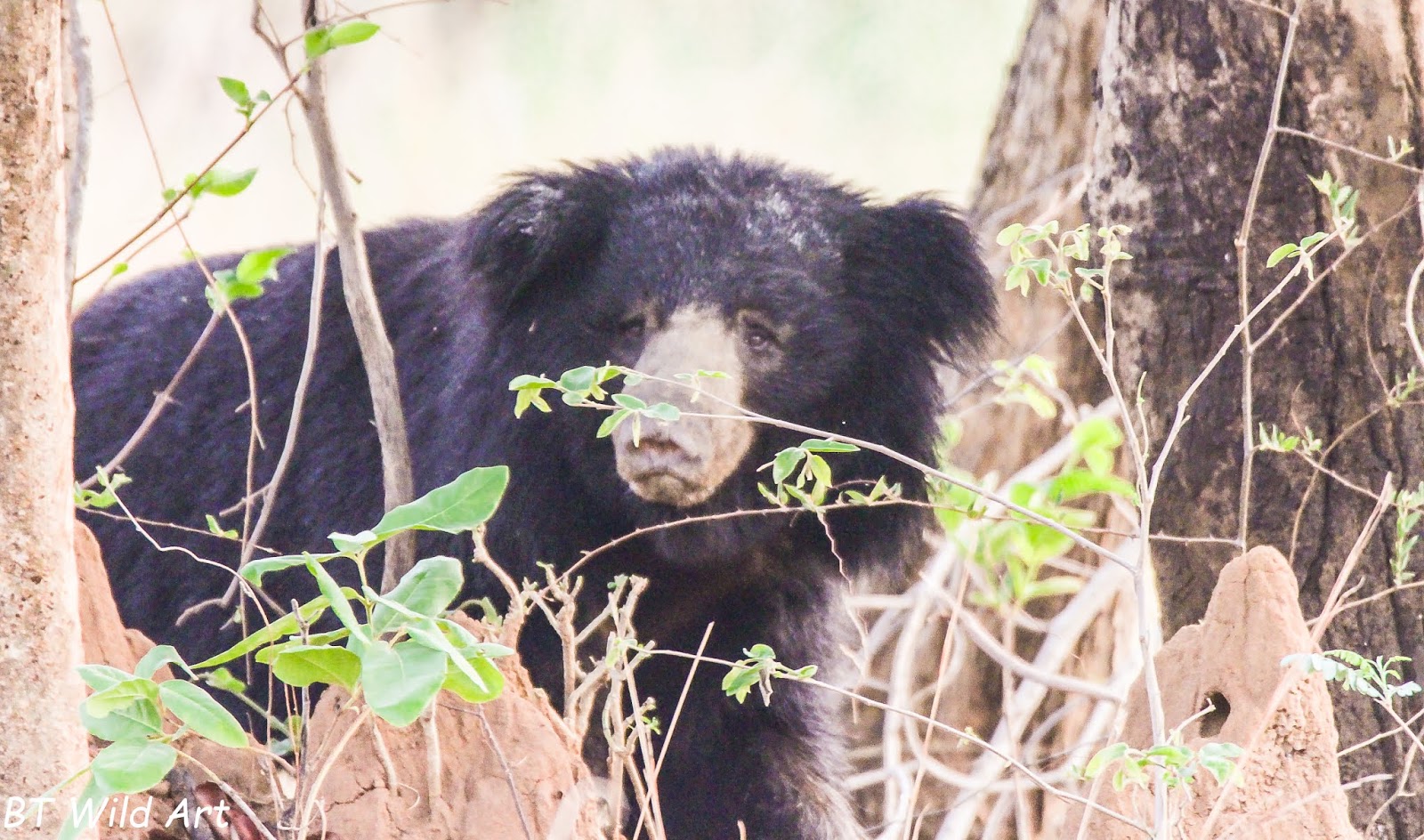
Hello lovely readers, I hope you all enjoyed the festival of colors, do share your unique experience with me here on the blog. Being a Sunday I opened my jungle book (my DSLR world) to check what can I offer you today, on referring picture portfolio I realized that animal write up is pending from some time as we have gone through trip report or birds on large scale. While I was thinking word jungle book it reminds me of some characters of Mowgli and then Baloo (Bhalu/Sloth Bear) clicked to my mind, so this is how we got the appointment of Baloo today. Let's meet Baloo closely in the next section.

Are you sure, I am Sloth?

How much we know about our own Baloo, only the extent of Mowgli’s world and nothing more hence, I take this opportunity to spread awareness about this cute and shy animal. The topic itself start with uniqueness, the heading is in question frame so let me answer  the question which will help you to understand the story behind having such interesting name


Sloth bears are a bit misleading by name, the word sloth means lazy/unwillingness/slow moving mammal etc but sloth bears are not related to sloths, and they are not slow moving. In fact, they’re agile bears that can run faster than a human and will attack if surprised. It was a European zoologist, George Shaw, who named the sloth bear for its long, thick claws and unusual teeth. He thought that the bear was related to the tree sloth due to these features. Sloth bears sometimes hang upside down on tree branches, much like a tree sloth. 

This animal is different in appearance and habits from other animals, it is very shy and run away if it notices any disturbance. It is difficult to capture in a photogenic frame as it hardly stops if it smells human presence. As I said it is different by habits as well so let's learn a few things related to habits and diets in the next section.


Extraordinaire Habits and Diets Habits:

Sloth bears adapt well to many different habitats. They live in the hot, dry grasslands and forests. You must be thinking if sloth bear likes hot and dry land how it is surviving with such coated body? Let me tell you in the wild everything is made by God in such a way that each thing has meaning to it. The coat protects them from being bitten by their favorite food—termites! It also gives sloth bear cubs something to grip when their mothers carry them on their backs. They often sleep in caves and near rivers when available. Sloth bears tend to be nocturnal when living around humans. But without human disturbance nearby, they are often active during the day. Now let us see what diet it takes.

Diets

The way they eat is interesting, Sloth bears feed predominantly on termites and ants and employs a well-evolved method to dig them out. Their long, curved claws are used for penetrating nest mounds, which can be rock-hard. Once they’ve opened a hole, they blow away excess dirt then noisily suck out the insects through a gap in their front teeth. To do so, they close their nostrils and use their lips like a vacuum nozzle. Apart from termites they also feed on a variety of fruit and flowers, including mango, fig, and ebony. They are also known to scale the occasional tree to knock down a bee honeycomb, which they will then enjoy on the ground below. It is this habit that’s given rise to their nickname, honey bears. One more thing for which bears are mad is Mahuwa flowers (Madhuca longifolia) they are crazy for Mahuwa flowers and hence you can sight them more frequently in MP forests during Mahuwa season.

I hope you enjoyed the basic details of our own Baloo since we all know about how it looks and all I will prefer to provide you some unknown facts of this lovely animal in the next section.

Fantastic facts 

Sloth bears aren’t very vocal but can make an impressive roar if needed for defense. A mother with a cub clinging to her back was observed scaring off not one but two tigers with her roar! Recently a video of sloth bear fighting with a famous tiger of Tadoba went viral where sloth bear managed to defense and finally tiger had to move back. You can find the same on YouTube https://www.youtube.com/watch?v=Bo2kHm8s2EY


The breeding season for sloth bears varies according to location: In India, they mate in April, May, and June, and give birth in December and early January. Litters usually consist of one or two cubs, or rarely three. Cubs are born blind and open their eyes after four weeks

The sloth bear often has a white patch of fur on its chest in the shape of a Y, O, or U. With a stocky body and powerful legs, this medium-size bear is able to climb trees. The sloth bear cannot pull in its claws like a cat's, so it looks a bit awkward when walking

Sloth bears tend to shuffle along slowly when walking but are able to run at speeds of around 40-50kph. However, they cannot maintain this pace for long

The animal is such a unique mammal that it is difficult to describe in limited words hence I opted to provide selective and interesting details only. While ending the blog I would like to through light on the conservation status of Sloth bear that needs urgent attention, please read facts pertaining to conservation and help us to save such an attractive mammal


Threats to Survival


Sloth bears are considered vulnerable animals. They are threatened by habitat loss and are sometimes captured for use in performances or hunted because of their aggressive behavior and destruction of crops. It is listed as Vulnerable on the IUCN Red List, mainly because of habitat loss and degradation. There is urgent attention required to save this wonderful animal else we will be able to see them only in books

A Message of the Day 

Save Life. Save Wildlife - The ones who have no voice need you to speak up

Author:

BT Wild Art
Life is Safari. Enjoy it.


The Photo Safari


Sunday, 17 March 2019

Awesome Ostrich


Happy Sunday to all my readers, the festival of color is round a corner please enjoy the colorful festival with Mother Nature it will take you to a different world altogether. Every weekend the challenge is to find a topic and but due to your love and somehow I manage something unique. After long thought and searching the photo book I found something different in bird category, the reason is because it is a bird but cannot fly, a flightless bird yes it's true hence it is unique. The bird is Ostrich world’s tallest but flightless bird. Let me tell you more about the awesome bird in the next section.

Uncommon Ostrich

Ostrich standout different from all other birds, reasons are countless some of them are the habit, style, nature, physic and many more. Each thing attached to Ostrich is different and unique, let me start with the basic details of the bird and then we will see some excellent quality of this lovely bird. 

To start with, let me tell you that it is the largest living bird in the world. The adult male can reach up to 9 to 10 feet tall where the neck is of almost half size of total height.

Since the height is such that weight is also on the higher side which is almost 150kg. Since I told you height and weight, guess the size of the egg 😮. Speechless, the egg reaches 6 inches in length and with 5 inches diameter, its weight reaches up to 1.5 kg that is again world’s largest egg of any bird.

As I told you everything is just outstanding from this gigantic bird, now let me update you on how it looks and what it prefers to eat. Male is mostly black with white plumes in the wing whereas the female is brown but the head and neck part is reddish to bluish tone. The head is relatively small with a wide short bill and big brown eyes but let me tell you that legs including thighs are the most powerful part of Ostrich’s body.

Ostrich relies on its strong legs—uniquely two-toed, with the main toe developed almost as a hoof—to escape its enemies, chiefly humans, and the larger carnivores. A frightened ostrich can achieve a speed of 72.5 km (45 miles) per hour. If cornered, it can deliver dangerous kicks.

Ostriches live mainly on vegetation but also take some animal food, mainly insects; they can go without water for long periods. Breeding males emit lion-like roars and hisses as they fight for a harem of three to five hens. This basic introduction will help you to imagine the architecture of this tallest bird. Since we know basic details we can explore some unheard, unmatched unique details of this massive bird. 

Uncommon, Unmatched, Unique शुतुरमुर्ग 

The heading states 3U which makes this bird an ultimate one, let’s see some rare qualities of Ostrich

Ostriches have three stomachs, I know it is difficult to believe but it is true

A metabolic renal study was carried out by dehydrating young, healthy ostriches for 2 days, the period during which urine was still excreted. Ostriches differ from other birds, in that they excrete urine separately from faeces

Ostriches’ wings reach a span of about 2 meters and are used in mating displays, to shade chicks, to cover the naked skin of the upper legs and flanks to conserve heat, and as “rudders” to help them change direction while running

Long legs are used as formidable weapons, capable of killing a human or a potential predator like a lion with a forward kick

Territorial fights between males for a harem of two to seven females usually last just minutes, but they can easily cause death through slamming their heads into opponents

The Ostrich is farmed around the world, particularly for its decorative feathers and also for its meat which is marketed commercially and its skin is used for leather products

Contrary to popular belief, ostriches do not bury their heads in the sand: the myth probably originates from the bird’s defensive behavior of lying low at the approach of trouble and pressing their long necks to the ground in an attempt to become less visible

Ostriches can go without drinking for several days, using metabolic water, moisture in ingested roots, seeds, and insects, but they enjoy liquid water and frequently take baths where it is available

The ostrich has the largest eye of any land animal, measuring almost 5 cm across, allowing predators such as lions to be seen at long distances

Whenever you visit Africa for wilderness, ensure that you find one, it is great to watch one of the largest but flightless bird in the world. With this note ending the blog and leaving you with my memory of Ostrich

A Message of the Day 

After they disappear, will you then shed a tear? Save wildlife. Save life 

Author:

BT Wild ArtLife is Safari. Enjoy it.


The Photo Safari


Male Ostrich

Female Ostrich